The Best Handguns to Take Hunting
A practical guide to choosing a defensive sidearm to carry while hunting, matched to varmints, large predators, and human threats across different environments.
Published September 2, 2026
How to Use This Guide
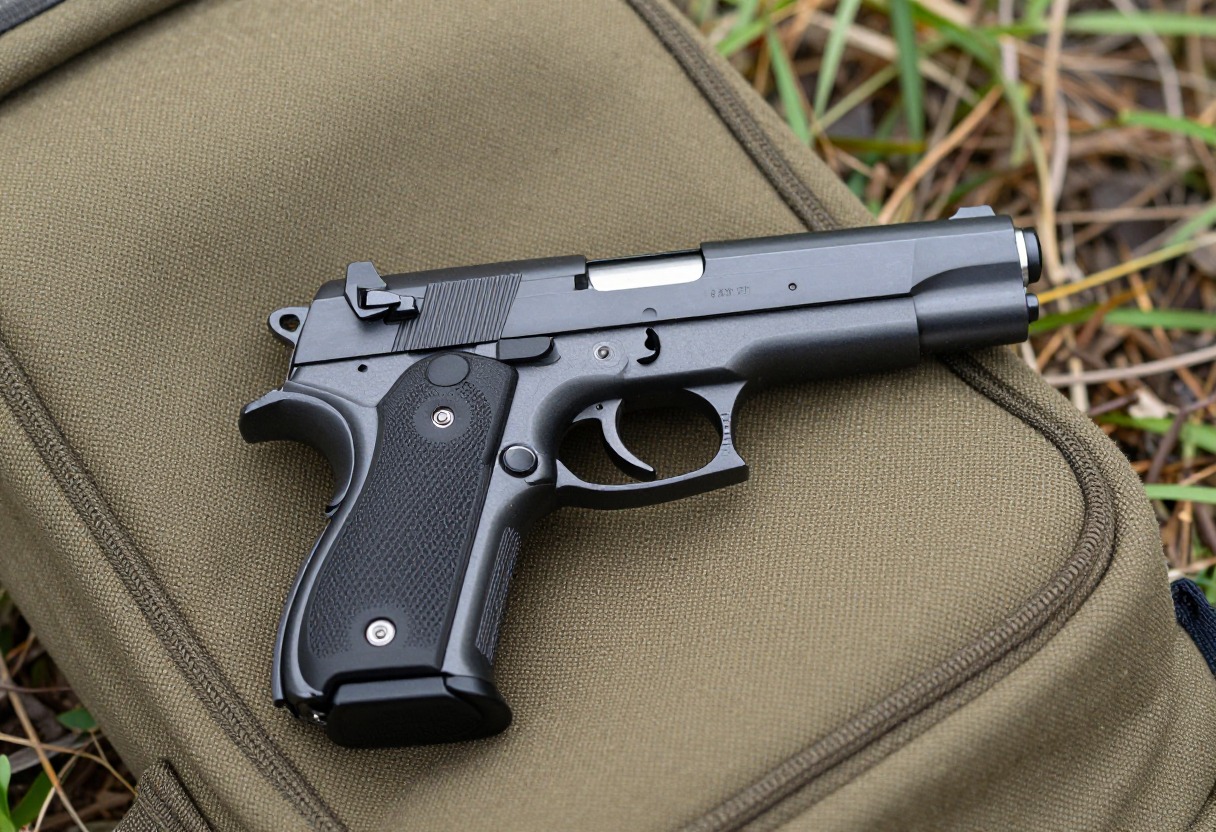
This guide is about defensive sidearms carried while hunting, not handguns used to take game. The pistols covered here — from Glock, Smith & Wesson, H&K, and Beretta — are backup protection against varmints, large predators, and human threats you might encounter in the field, not your primary hunting weapon. That distinction matters for two reasons: it changes which caliber and features actually matter, and it changes which regulations apply, since carrying a sidearm for defense while hunting is often governed differently than the firearm you're using to hunt with.
1. Why Carry a Sidearm While Hunting At All
A rifle or bow in hand is often the better first response to a threat encountered during an actual hunt. A defensive sidearm covers the gaps: the walk in and out with your long gun slung and unloaded, time spent field dressing game (a genuine bear attractant), downtime around a remote camp, and any moment your primary weapon isn't immediately usable.
| Threat Category | Typical Scenario | Why a Sidearm Helps |
|---|---|---|
| Varmints & small aggressive animals (coyotes, feral dogs, venomous snakes) | Sudden, close-range encounter | Faster to present than an unslung or unloaded long gun |
| Large predators (black bear, brown/grizzly bear, mountain lion, aggressive feral hogs) | Very close range, often sudden, frequently during field dressing | Last-resort defense when your rifle isn't in hand or has already been fired |
| Human threats (property disputes, poachers, general remote-area safety) | Variable | Same self-defense logic as everyday concealed carry, applied in a hunting context |
2. Caliber Considerations for Defensive Carry
Defensive carry priorities are different from hunting-caliber priorities: fast, accurate follow-up shots under stress matter more than long-range performance.
| Caliber | Typical Role | Recoil / Follow-Up Speed | Notes |
|---|---|---|---|
| 9mm | Human & varmint defense | Light, fastest follow-up | Modern premium defensive ammunition has closed much of the performance gap with larger calibers; the most common caliber across all four brands here |
| .40 S&W | Human & varmint defense | Moderate | A middle-ground caliber; the broader handgun industry has trended back toward 9mm over the last decade |
| .45 ACP | Human & varmint defense | Moderate | Larger diameter, proven service history, offered by all four brands |
| 10mm Auto | Human, varmint, and large predator defense | Firm, slower follow-up than 9mm | Widely cited by backcountry and Alaska guides as a reasonable minimum for handgun-based black bear defense when loaded with hard-cast or deep-penetrating bullets; available in Glock and Smith & Wesson |
| .44 Magnum (revolver only) | Large predator defense | Heavy, lowest capacity | The traditional bear-defense standard before 10mm's rise; proven track record, only available among these brands from Smith & Wesson |
Be honest about the limits here: no handgun caliber is a confident first choice against a charging brown or grizzly bear. Bear spray has a strong, well-documented success record and is generally recommended by wildlife agencies as the first response — a sidearm is a backup, not a replacement for it.
3. Semi-Auto vs. Revolver for Field Carry
Three of these four brands — Glock, H&K, and Beretta — build exclusively semi-automatic pistols. Semi-autos offer more capacity, faster reloads, and a flatter profile for carry under hunting layers. Smith & Wesson is the outlier: alongside its own modern semi-autos, it's the only brand of the four with genuine big-bore revolver options (the Model 629 in .44 Magnum, and the X-Frame line in .460 and .500 S&W Magnum) — the step-up choice for the most serious predator country, at the cost of low capacity and heavy recoil.
4. Brand-by-Brand Breakdown
Glock
- Known for: simplicity, reliability in dirt, cold, and minimal-cleaning field conditions, and the widest aftermarket holster support of any of these four brands.
- Relevant models: G19/G17 (9mm, all-around field carry), G21 (.45 ACP), G20/G29 (10mm Auto, full-size and compact) — the 10mm models are a genuinely popular choice among Alaska guides and backcountry hunters specifically for bear-defense duty.
- Best for: hunters who want one low-maintenance platform, with a real step-up option (10mm) built into the same brand for serious predator country.
Smith & Wesson
- Known for: the widest range within a single brand — modern polymer duty pistols alongside classic steel-frame revolvers.
- Relevant models: M&P M2.0 (9mm/.40 S&W/.45 ACP), M&P Shield (compact concealed carry), Model 629 (.44 Magnum revolver), X-Frame (.460/.500 S&W Magnum revolvers — the most powerful production handguns available, purpose-built for serious large-predator defense).
- Best for: hunters who want either a modern duty-style pistol or the option to step all the way up to a true magnum revolver.
Heckler & Koch (H&K)
- Known for: premium build quality and an exceptional reliability record, widely used by military and law enforcement units.
- Relevant models: VP9 (modern striker-fired, 9mm), USP (hammer-fired, 9mm/.40 S&W/.45 ACP, with a strong service record in harsh conditions), P30.
- Best for: hunters prioritizing build quality and reliability in human/varmint-defense calibers. H&K doesn't currently offer a 10mm option, so it isn't the pick for hunters specifically prioritizing serious bear-country power.
Beretta
- Known for: a long, proven service history — the 92FS served as the U.S. military's M9 sidearm for decades — and smooth double-action triggers.
- Relevant models: 92FS (9mm), PX4 Storm (9mm/.40 S&W/.45 ACP).
- Best for: hunters who prefer a proven, traditional double-action pistol. Like H&K, Beretta's lineup is best suited to human/varmint-defense roles rather than serious large-predator defense.
5. Matching the Gun to the Environment
| Environment | Primary Concern | Suggested Direction |
|---|---|---|
| Eastern woodland whitetail country | Human threats, occasional varmints | Compact 9mm (Glock 19, M&P Shield, HK VP9, Beretta 92FS/PX4) for concealable, fast-presenting carry |
| Western open country / varmint-heavy terrain | Coyotes, occasional mountain lion | Mid-size 9mm or .45 ACP, comfortable for all-day carry |
| Grizzly / brown bear backcountry (Alaska, Northern Rockies, interior Canada border regions) | Large predator encounters | 10mm Auto (Glock 20/29, S&W M&P10mm) as a minimum, or step up to a .44 Magnum/X-Frame revolver — always paired with bear spray, never in place of it |
| Public land with heavy human traffic or known property disputes | Human threats | Prioritize a caliber and capacity you're confident and practiced with over raw power — this is a fast, close-range self-defense scenario, the same as any concealed carry situation |
6. Carry Method: Holsters for the Field
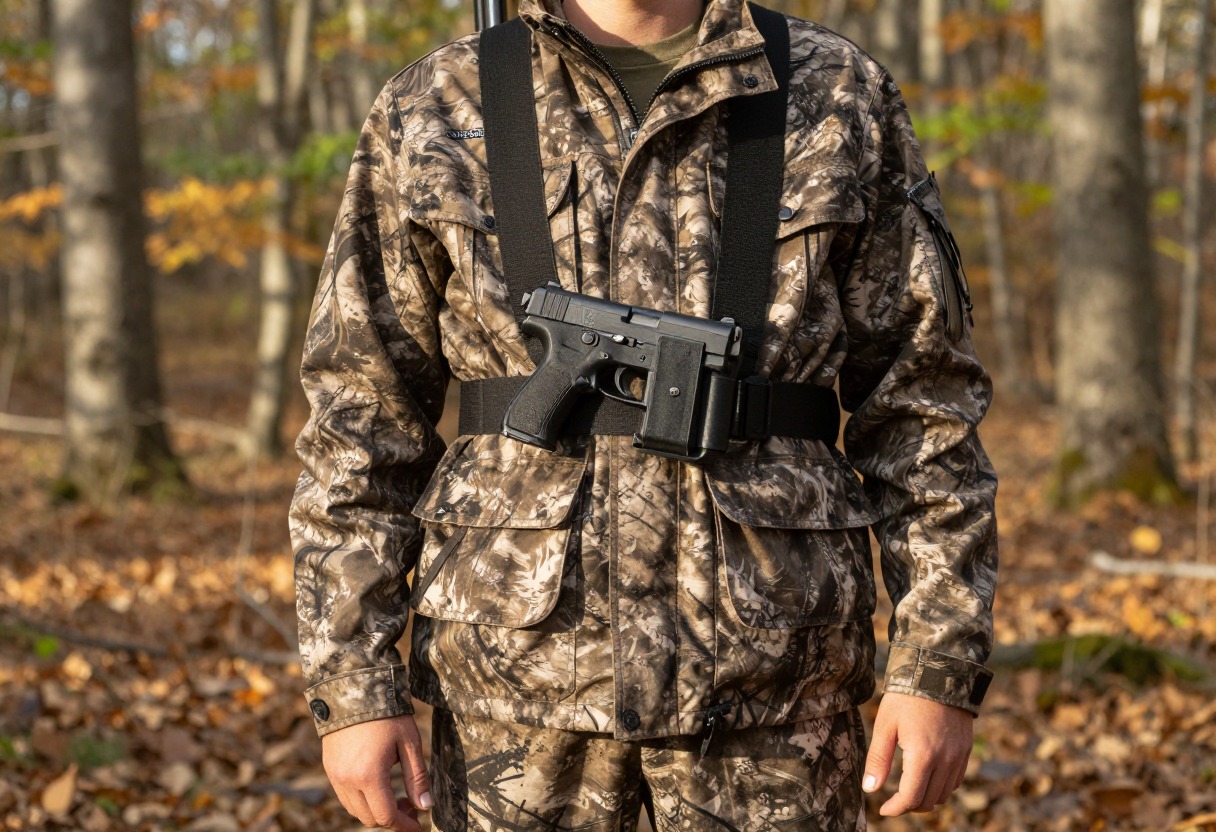
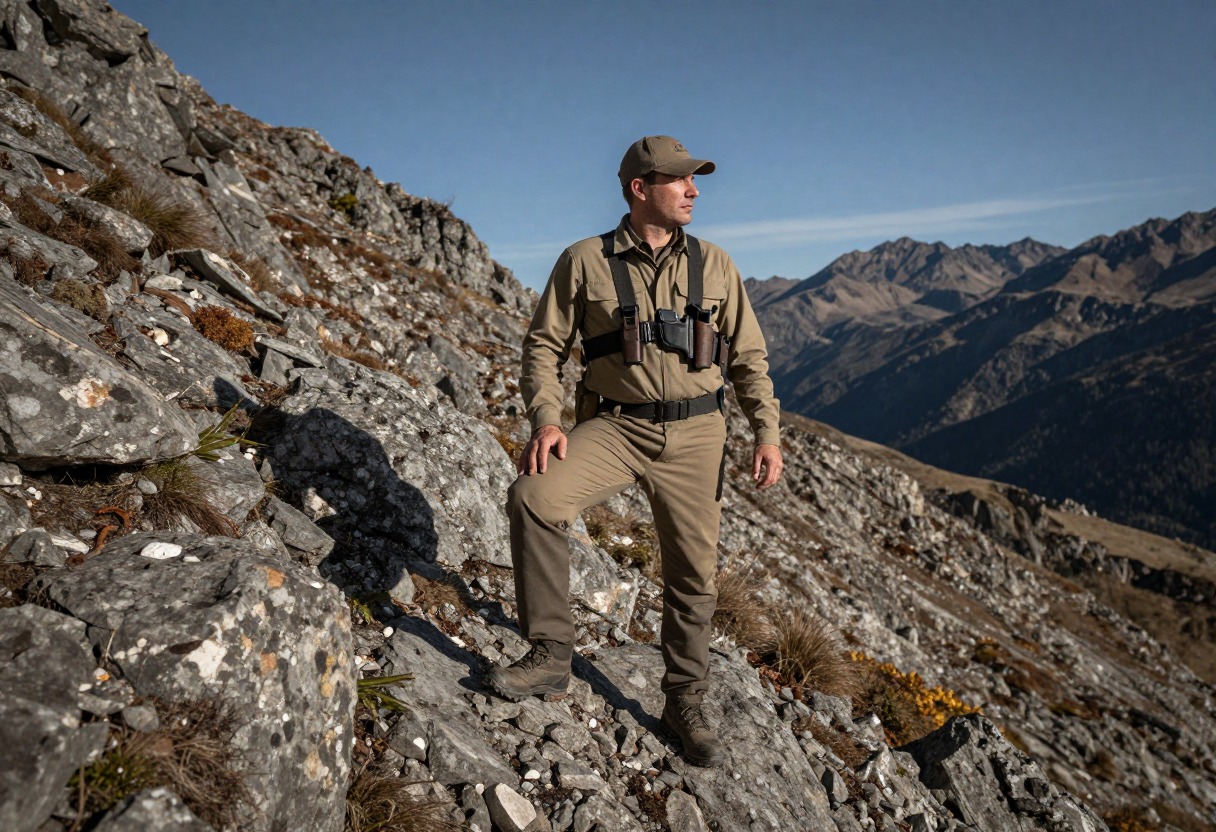
- Chest holster: the standard recommendation for backcountry and bear-country hunting — stays accessible over layered clothing and jackets, and doesn't compete with a hunting pack's hip belt.
- Hip/belt holster: familiar and comfortable, but can be blocked by a pack's waist belt or bulky cold-weather layers.
- Drop-leg holster: keeps the gun clear of both pack and belt; more common in tactical carry than traditional hunting circles.
- Shoulder holster: works under heavy jackets in cold-weather hunts, but is slower to present than the fast draw modern defensive carry emphasizes.
- Whatever method you choose, retention level, glove compatibility, and a practiced one-handed draw matter more than the specific style.
7. Bear Country Special Considerations
- Bear spray has a strong, well-documented track record and is generally recommended by wildlife agencies as the first response to a bear encounter. A handgun is a backup, not a replacement, and shouldn't be the only tool you carry in serious bear country.
- Shot placement on a fast-moving, charging animal under extreme stress is far harder than range practice suggests. Caliber choice matters less than your ability to hit a vital area under that stress — which argues for practicing actual draw-and-fire drills, not just marksmanship at a static target.
- Carry your sidearm loaded and immediately accessible — buried in a pack defeats the purpose in a sudden encounter.
8. Legal Considerations
Whether you can legally carry a handgun while hunting, and under what conditions, varies by state, by the land manager (a national forest, national park, state wildlife management area, and national wildlife refuge can each have different rules), and sometimes by the specific tag or hunt type. Concealed carry permit reciprocity between states matters if you hunt across state lines — a permit valid at home isn't automatically valid where you're hunting. Self-defense use-of-force law also varies by state, and using a firearm against a person carries serious legal consequences regardless of circumstances.
Check official sources before you go: your state's resources page links to the official wildlife agency for hunting-specific rules, and your state's official permitting authority covers carry reciprocity. Our guide to understanding hunting licenses and regulations covers the broader regulatory landscape this fits into.
9. Practice and Readiness
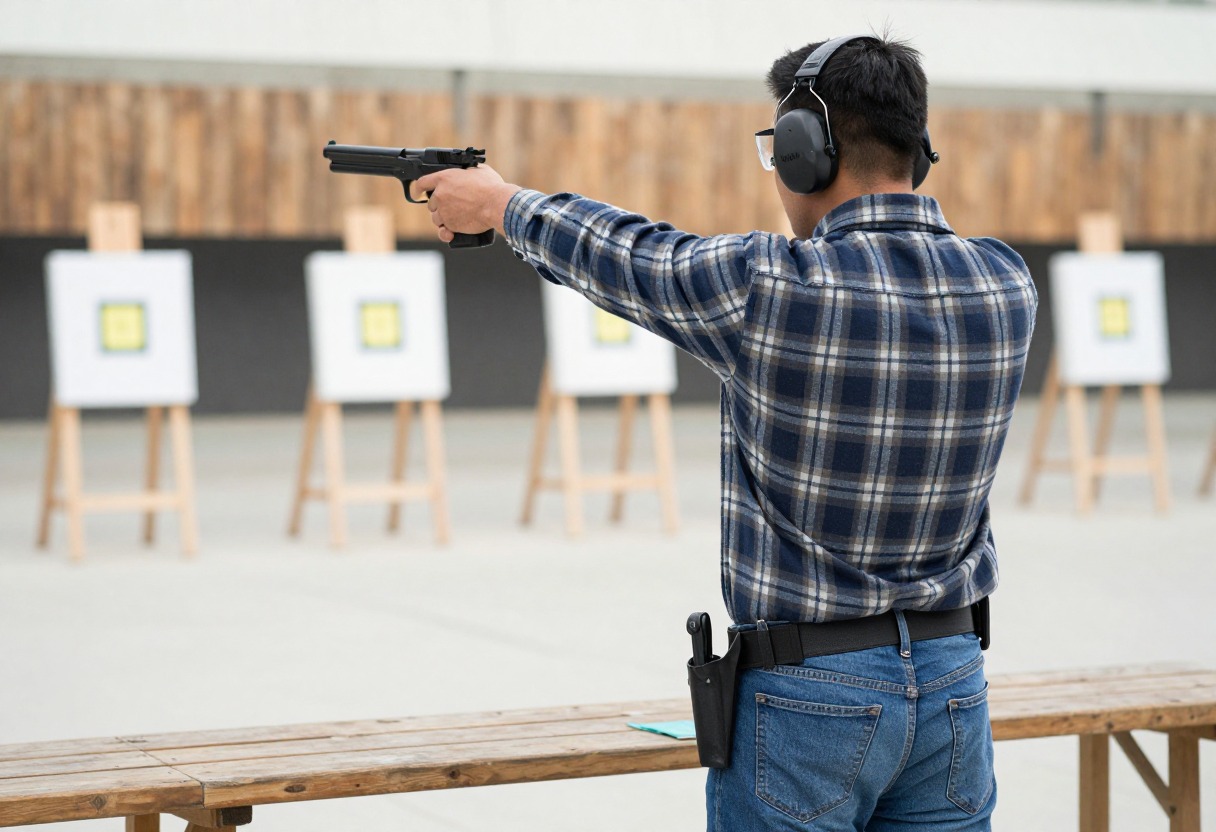
- Practice drawing from your actual field carry position — a chest holster over hunting layers with gloves on — not just from a range holster over a t-shirt.
- Practice one-handed manipulation; a real encounter may happen while your other hand is holding a rifle, binoculars, or a pack strap.
- Confirm your gun and holster work reliably with gloves on and in cold weather, both of which change trigger feel and draw speed.
- Treat your carry gun with the same regular practice as your hunting rifle, not as an occasional afterthought.
- Our guide to hunting safety and firearm handling covers the core safety fundamentals that apply to any firearm you carry in the field.
Quick Decision Checklist
- I understand this sidearm is for defense, not for harvesting game
- I've matched my caliber choice to the most serious threat in my specific hunting environment
- I've chosen a caliber and platform I can draw and fire quickly and accurately under stress
- I carry bear spray as my first response in serious bear country, not just a handgun
- I've chosen a carry method (chest, hip, drop-leg) compatible with my pack and clothing layers
- I've confirmed my state's and land manager's specific rules on carrying a handgun while hunting
- I've checked concealed carry reciprocity if hunting out of state
- I practice drawing and firing from my actual field carry position, not just from a range holster
Glossary
- Defensive Carry: Carrying a firearm for protection rather than as the primary tool used to take game.
- 10mm Auto: A semi-automatic pistol cartridge offering significantly more power than 9mm, .40 S&W, or .45 ACP, commonly cited as a reasonable minimum for handgun-based black bear defense.
- Hard-Cast Bullet: A solid, non-expanding bullet designed for deep, straight-line penetration, generally preferred over expanding hollow-points for large-predator defense.
- Reciprocity: The legal recognition of one state's concealed carry permit by another state.
- Chest Holster: A holster worn on the chest, typically over a jacket or pack strap, favored in backcountry and bear-country hunting for accessibility.
This guide covers general principles for defensive sidearm selection and is not legal advice. Laws governing concealed carry, self-defense, and carrying a firearm while hunting vary significantly by state and by public land management agency, and change over time — always confirm current, specific requirements for your exact situation before you go.