
Water Filtration and Purification for Camping
Filters, purifiers, and chemical treatment compared, so you never have to guess if water is safe to drink.
Published August 19, 2026
Why "Just Boil It" Isn't the Whole Answer
Boiling works, but it's not always practical — it costs fuel and time, and on a hot day the last thing you want is a liter of steaming water. Understanding the real tradeoffs between filters, purifiers, and chemical treatment lets you choose the right method for the trip instead of defaulting to whatever's most familiar. This guide breaks down what each method actually removes, where each one falls short, and how to match a method to your specific water source and trip style.
1. The Three Threats in Untreated Water
Before comparing methods, it helps to know what you're actually treating for — different methods handle different threats.
| Threat | Examples | Typical Size |
|---|---|---|
| Protozoa | Giardia, Cryptosporidium | Largest — 1–15 microns |
| Bacteria | E. coli, Salmonella, Campylobacter | Mid-size — 0.2–1 micron |
| Viruses | Hepatitis A, Norovirus, Rotavirus | Smallest — 0.02–0.2 micron |
This size hierarchy matters because it's the basis for the core distinction in this guide: filters physically strain out particles above a certain size, while purifiers (chemical or UV) inactivate organisms regardless of size, including viruses that are often too small for a standard filter to catch.
Practical note on North American backcountry water: in most of the US and Canada, protozoa and bacteria are the primary practical concern; viruses are a comparatively low risk in backcountry water specifically (they're a bigger concern in developing regions or after natural disasters affecting municipal water). This context matters when deciding how much virus protection you actually need for a given trip.
2. Filters: Mechanical Straining
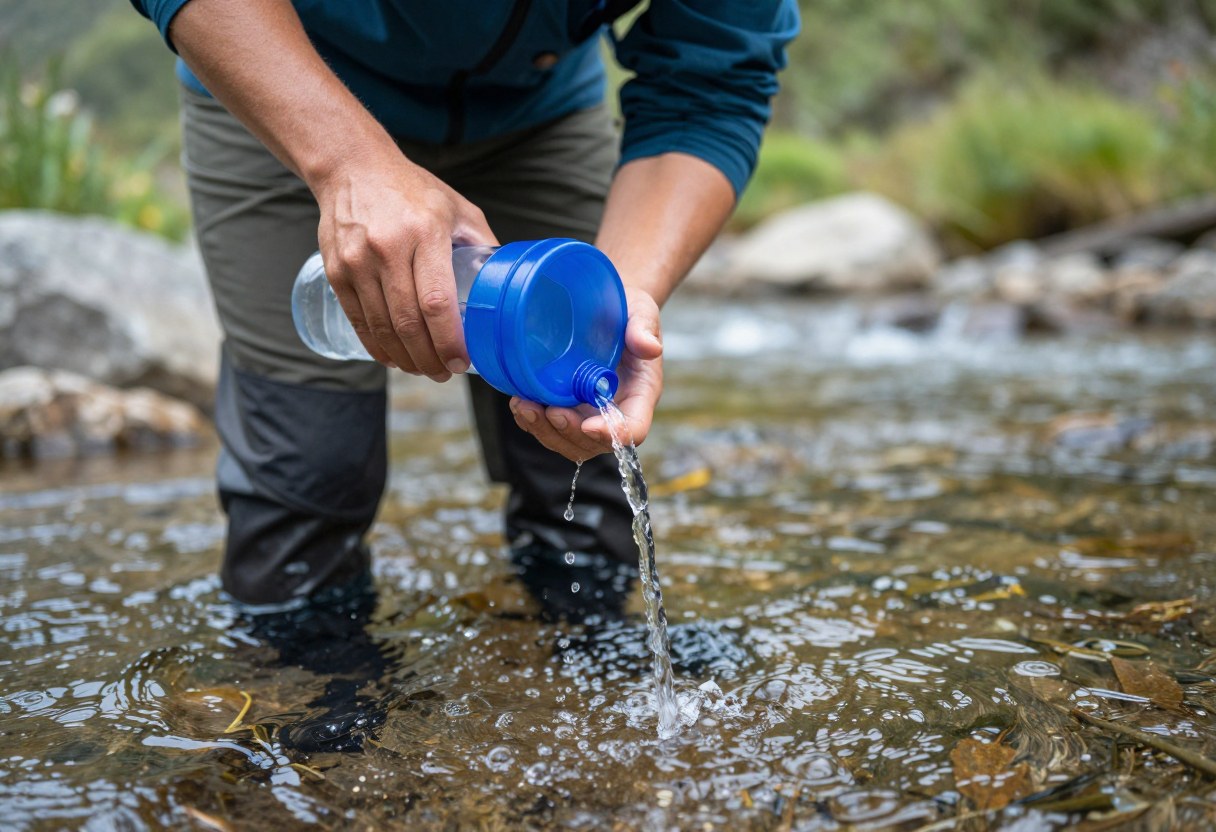
Filters physically block organisms larger than their pore size from passing through, typically using a hollow-fiber membrane, ceramic element, or similar physical barrier.
What Filters Remove
- Protozoa: Yes, reliably — filter pore sizes (commonly around 0.1–0.2 microns) are well below protozoa size.
- Bacteria: Yes, generally — most quality filters rated at 0.2 microns or smaller catch bacteria effectively.
- Viruses: Generally no — viruses are frequently smaller than standard filter pore sizes and pass through most consumer camping filters.
- Sediment and particulates: Yes — this is a genuine added benefit filters provide that chemical/UV purification doesn't, improving taste and clarity alongside safety.
Common Filter Types
| Filter Type | How It Works | Pros | Cons |
|---|---|---|---|
| Pump filters | Hand-pumped through a filter cartridge into a container | Can filter directly from shallow or hard-to-reach sources | Slower, more effort, more moving parts to maintain |
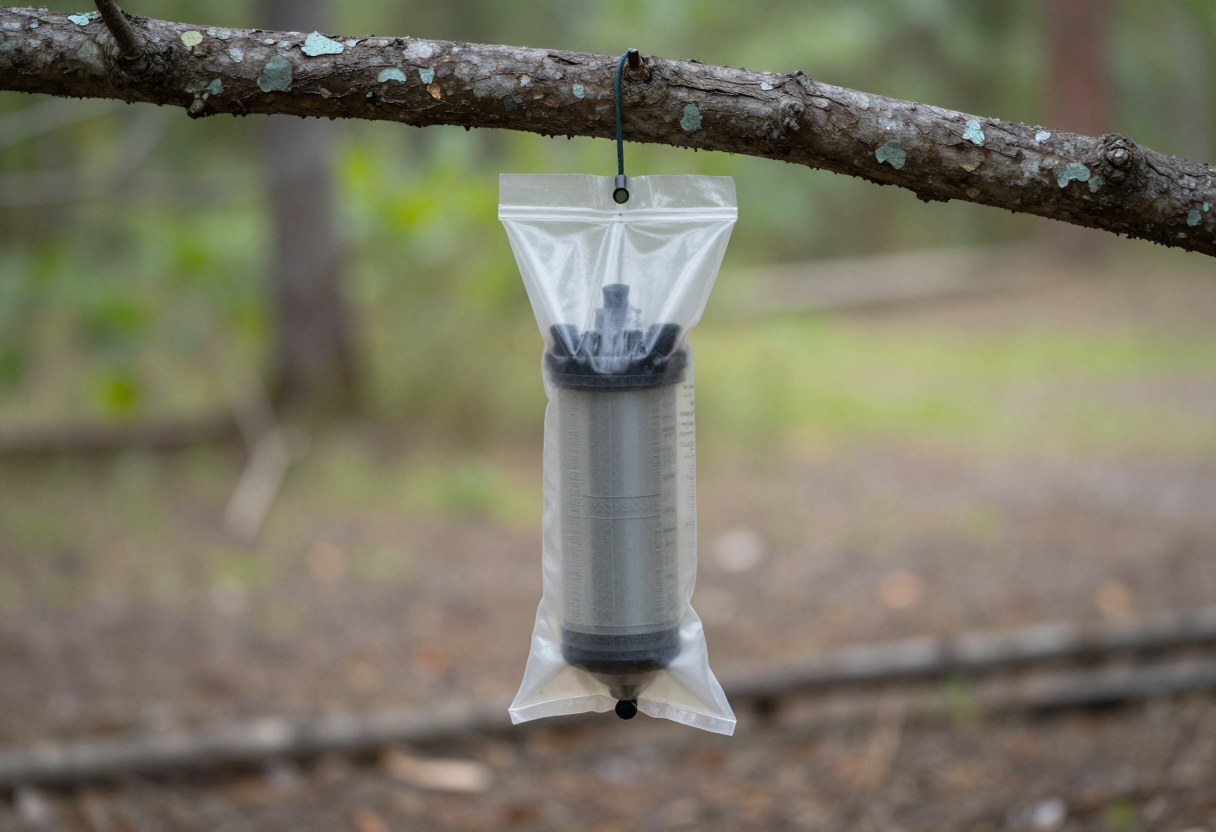
| Gravity filters | Water flows through a filter via gravity from a hanging reservoir | Hands-free, good for filtering larger volumes for groups | Requires a hang point, slower for a single quick fill |
| Squeeze filters | Filter attached to a soft flask/bag, water squeezed through | Lightweight, fast, minimal parts — a very popular backpacking choice | Can clog with sediment-heavy water; manual effort per liter |
| Straw filters | Drink directly through a filter straw, or filter into a bottle | Extremely lightweight and simple; good emergency/backup option | Not practical for filling containers for later use or cooking |
| Bottle filters | An integrated filter built into a water bottle cap/straw | Convenient all-in-one design | Limited flow rate and volume per fill compared to dedicated systems |
Filter Maintenance
- Backflushing (running clean water backward through the filter) clears trapped sediment and restores flow rate — most filters include a backflush syringe or method, and skipping this is the most common reason a filter's flow rate drops over a trip.
- Filter lifespan is measured in liters (often several hundred to a few thousand liters depending on the model and water clarity) — sediment-heavy water clogs a filter faster than clear water, shortening its effective life.
- Freezing can permanently damage hollow-fiber filters, cracking the internal membrane in ways that aren't visible but compromise filtering effectiveness — a real risk on cold-weather trips if a filter isn't kept from freezing overnight (many backpackers sleep with the filter in their sleeping bag on cold nights specifically to prevent this).
3. Purifiers: Chemical and UV Treatment
Purifiers work differently from filters — instead of physically blocking organisms by size, they inactivate or kill them, which means they can address viruses that pass through standard filter pore sizes.
Chemical Treatment (Iodine and Chlorine Dioxide)
| Chemical | Effectiveness | Notes |
|---|---|---|
| Chlorine dioxide (tablets or drops) | Effective against protozoa, bacteria, and viruses | The more commonly recommended chemical option today; effective against Cryptosporidium with sufficient contact time, unlike iodine |
| Iodine (tablets or drops) | Effective against bacteria and viruses; less reliable against Cryptosporidium | Older, historically common method; not recommended for pregnant individuals, those with thyroid conditions, or prolonged/repeated use due to iodine intake concerns |
How chemical treatment works: the chemical is added to water and allowed sufficient contact time (often 30 minutes for standard treatment, longer — sometimes 4+ hours — for full effectiveness against Cryptosporidium specifically, depending on the product and water temperature) to inactivate pathogens.
Pros of chemical treatment:
- Extremely lightweight and compact — a real advantage for ultralight backpacking or as a reliable backup method.
- No moving parts to clog, break, or maintain.
- Effective against viruses, unlike standard filters.
Cons of chemical treatment:
- Doesn't remove sediment or improve taste/clarity — chemically treated water can still look and taste like its untreated source, just without living pathogens.
- Requires waiting time, which can be inconvenient mid-hike or when water is needed quickly.
- Cold water significantly slows chemical effectiveness, often requiring extended contact time beyond the standard recommendation in near-freezing water.
- Taste, particularly with iodine, is a common complaint — some products include a neutralizing tablet to address this.
UV Purification
How it works: A UV light device (commonly a UV pen or similar) is submerged in and stirred through water for a set time, using ultraviolet light to disrupt the DNA/RNA of pathogens, including viruses, bacteria, and protozoa, preventing them from reproducing and causing illness.
Pros of UV purification:
- Fast — typically 60–90 seconds per liter, notably quicker than chemical treatment's wait time.
- Effective against viruses as well as bacteria and protozoa.
- Doesn't affect taste, unlike chemical treatment.
Cons of UV purification:
- Requires batteries or charging, a real point of failure on longer trips without a reliable way to recharge.
- Doesn't work well in cloudy/turbid water, since suspended particles can shield organisms from UV exposure — pre-filtering cloudy water is often recommended before UV treatment.
- Doesn't remove sediment, similar to chemical treatment — water clarity and taste are unaffected.
- Generally the most expensive per-unit option among the methods covered here.
4. Boiling: The Universal Fallback
Boiling is the most universally reliable method, effective against all three threat categories (protozoa, bacteria, viruses) with no equipment beyond a heat source and container.
- A rolling boil for one minute is generally considered sufficient at most elevations; at elevations above roughly 6,500 feet (about 2,000 meters), extending to three minutes is commonly recommended, since water boils at a lower temperature at altitude.
- Pros: No specialized gear required beyond what most campers already carry (stove, pot); universally effective against all pathogen types; no membrane to clog or chemical taste to manage.
- Cons: Uses fuel and time, which matters on longer trips or fuel-limited setups; doesn't remove sediment or improve taste/clarity; requires cooling before drinking, which adds more time.
- Best use case: A reliable backup method always worth understanding even if you primarily rely on a filter or purifier day-to-day — useful if your primary method fails, and genuinely practical for car camping or basecamp situations where fuel isn't a tight constraint.
5. Combining Methods: Filter + Chemical/UV
For water sources of uncertain quality, or in situations where virus risk is a real concern (international travel, disaster response, very high-use water sources), combining a filter with a chemical or UV purification step provides the most complete protection:
- Filter first, then chemically treat or UV-treat — the filter removes sediment and larger organisms (improving both safety margin and taste/clarity), and the chemical/UV step addresses viruses the filter alone would miss.
- This combined approach is more relevant for international travel or higher-risk water sources than typical North American backcountry camping, where filtration alone is often considered adequate by most hikers and land management agency guidance — but it's worth understanding as an option for trips where you want maximum protection or are unsure of water quality risk in a specific region.
6. Choosing a Water Source Wisely (Before You Even Treat It)
Treatment method matters, but source selection is the first line of defense and shouldn't be skipped:
- Moving water is generally preferable to stagnant water, since flow reduces (though doesn't eliminate) some contamination concentration.
- Avoid water immediately downstream of visible contamination sources — livestock areas, trailheads with heavy foot traffic, or areas with visible algae blooms.
- Water higher in a watershed, away from human and animal activity, is generally lower risk, though "generally lower risk" is not the same as "safe to skip treatment" — treat all backcountry water regardless of how clean it appears.
- Clear water is not necessarily safe water. Visual clarity has no reliable relationship to pathogen presence — this is a common and dangerous misconception among new campers.
7. Matching Method to Trip Style
| Trip Type | Recommended Approach |
|---|---|
| Car camping (bringing your own water) | Often unnecessary if bringing sufficient water; a filter or chemical treatment as backup is still wise |
| Day hiking, single water refill | Chemical tablets (lightweight backup) or a squeeze filter for speed |
| Backpacking, multiple refills over a multi-day trip | Squeeze or gravity filter as primary, chemical tablets as lightweight backup for filter failure |
| Ultralight backpacking, minimizing weight | Chemical treatment alone, or an ultralight straw/squeeze filter |
| Group camping, filtering larger volumes | Gravity filter, given its hands-free, higher-volume design |
| Cold-weather/winter camping | Chemical treatment (accounting for extended cold-water contact time) or boiling, since filters risk freeze damage |
| International travel or uncertain water quality/virus risk | Filter combined with chemical or UV treatment for maximum protection |
| Backup/emergency method for any trip | Chemical tablets (lightweight, no moving parts, long shelf life) or knowledge of boiling as a fallback |
8. Common Mistakes
- Assuming clear-looking water is safe. Pathogen presence has no reliable connection to visual clarity.
- Relying solely on a filter in situations with real virus risk (international travel, disaster-affected municipal water) without adding chemical or UV treatment.
- Not backflushing a filter regularly, leading to a frustratingly slow flow rate partway through a trip.
- Letting a hollow-fiber filter freeze, silently damaging it in a way that isn't visible but compromises safety — protect filters from freezing on cold nights.
- Underestimating chemical treatment contact time, especially in cold water, where standard timing isn't sufficient for full effectiveness against Cryptosporidium specifically.
- Not pre-filtering cloudy water before UV treatment, reducing UV's effectiveness since suspended particles can shield pathogens from light exposure.
- Carrying only one method with no backup. A clogged filter, dead UV batteries, or lost chemical tablets can leave you without safe water if you have no fallback plan.
- Treating chemically treated water as equivalent to filtered water for taste/clarity. Chemical and UV methods don't remove sediment — worth knowing before assuming an unpleasant-looking water source will taste fine just because it's been purified.
9. Packing Recommendations
For most backcountry camping and backpacking trips in North America, a reasonable, low-risk approach is:
- A primary filter (squeeze or gravity, depending on group size and preference)
- A backup chemical treatment (tablets or drops), lightweight and reliable if the filter fails or clogs
- Knowledge of boiling as a last-resort fallback if both other methods are unavailable
- A plan to protect the filter from freezing on cold-weather trips
- Awareness of your specific destination's water quality risk profile, adjusting toward combined filter + chemical/UV treatment for higher-risk regions or international travel
Glossary
- Protozoa: Single-celled microorganisms (e.g., Giardia, Cryptosporidium) that are the largest of the three main waterborne pathogen categories, reliably removed by standard filters.
- Hollow-Fiber Membrane: A common filter technology using bundles of fine, porous fibers to physically strain pathogens from water.
- Contact Time: The required duration a chemical treatment must remain in water before it has fully inactivated targeted pathogens.
- Turbidity: The cloudiness or haziness of water caused by suspended particles, which can reduce the effectiveness of UV purification and clog filters faster.
- Backflushing: Running clean water backward through a filter to dislodge trapped sediment and restore flow rate.
Final Takeaway
Filters and purifiers solve different problems — filters physically remove protozoa, bacteria, and sediment but generally miss viruses; chemical and UV purifiers inactivate all three threat categories, including viruses, but don't improve taste or remove particulates. For most North American backcountry trips, a quality filter with a lightweight chemical backup covers the realistic risk profile well. For international travel or genuinely uncertain water sources, combining a filter with chemical or UV treatment provides the most complete protection. Whatever method you choose, always carry a backup, and never assume clear water is automatically safe water.
Water treatment guidance can vary by region and specific local water quality concerns — check with land management agencies or local health authorities for any region-specific advisories before a trip, particularly regarding chemical contamination that filtration and purification methods described here are not designed to address.